
A recent siding review
4.8 on Google★★★★★Google review"the quality of the siding installation came out beautiful. The house looks brand new."
Vinyl, Fiber Cement or Wood: What Are the Types of Siding?
Each material has its own rules in the 2025 California Residential Code. In a fire hazard zone, also ask for the label that shows the covering is approved for exterior use there (section 504.5.2). These are the three we install.
Vinyl siding
Must be certified and labeled to ASTM D3679 (section R703.11) and installed to the maker's instructions, starting from a starter strip on the first course (section R703.11.1.1).
Fiber cement siding
Panels and lap boards must meet ASTM C1186 (section R703.10). Lap boards overlap at least 1 1/4 inches, and butt joints are caulked, covered with an H-joint or set over flashing (section R703.10.2).
Wood siding
Lap boards, shingles or board-and-batten. Wood lap siding up to 6 inches wide is face-nailed with one 6d box or siding nail per bearing, and 8-inch and wider boards with two (Table R703.3(1)).
Fasteners
Unless the maker says otherwise, vinyl siding nails have a 0.120-inch shank and a 0.313-inch head, reach at least 1 1/4 inches into the nailable base and sit no more than 16 inches apart on horizontal siding (sections R703.11.1.3 to R703.11.1.5).
What Goes Up Before the Siding?
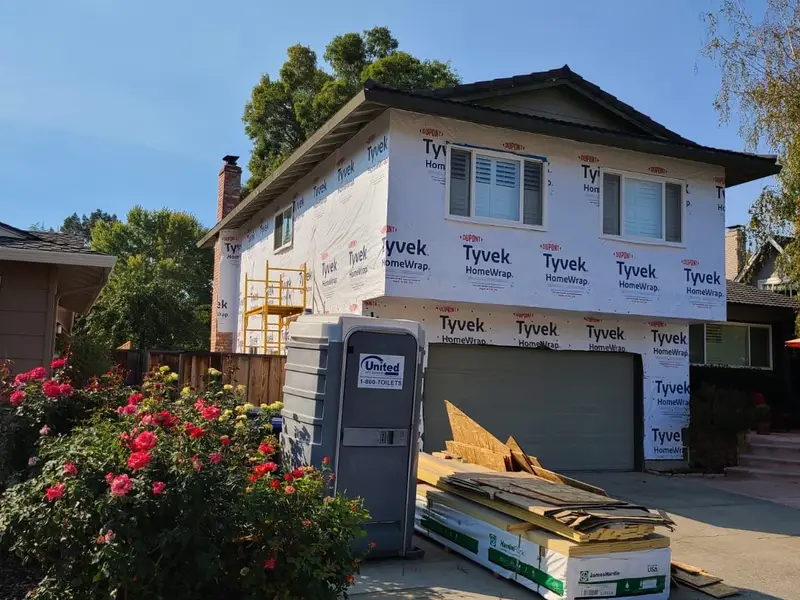
The siding sheds most of the rain; the layers behind it handle the water that gets past. The 2025 California Residential Code spells them out.
Sheathing repair
With the old siding off, soft or stained sheathing and framing show up and are replaced before anything new covers them.
Water-resistive barrier
At least one continuous layer of water-resistive barrier goes over the studs or sheathing of every exterior wall, including behind deck ledgers (section R703.2).
Flashing
Windows, doors and roof-to-wall joints are flashed so water that runs down the barrier is led back outside (section R703.4).
A way out for water
The wall must give water that gets behind the siding a way to drain to the outside (section R703.1.1), so the barrier is lapped shingle-style, upper layers over lower ones, behind the cladding (section R703.2).
Siding Rules in Fire Hazard Zones and When a Permit Applies
Approved wall coverings
In a fire hazard severity zone or a wildland-urban interface area, exterior wall coverings must be noncombustible, ignition-resistant material labeled for exterior use, or fire-retardant-treated wood, unless they are part of an approved fire-tested wall assembly (Wildland-Urban Interface Code sections 504.5 and 504.5.2).
Foundation to roof
In those areas the covering runs from the top of the foundation to the roof (section 504.5.2.1), and 6 inches of metal flashing or noncombustible material goes at the ground, deck and roof intersections (section 504.5.1).
Repairs and permits
Ordinary repairs need no permit application (section R105.2.2), and siding replacement is not on the code's list of permit-exempt work (section R105.2). Whether a re-side needs a permit is for your city or county building department to say, under its own amendments.
Windows and doors
Flashing at windows and doors follows the window maker's instructions; where there are none, a pan flashing goes under the sill, sealed or sloped to send water out (section R703.4.1). A re-side is the time to fix it.
Siding Repair or Full Replacement?
A few bad boards are a repair. These signs point to a problem behind the siding that a patch will not fix.
Soft or swollen boards
Boards that give when pressed, or swell at the ends, can mean water has been getting behind them.
Paint that keeps failing
Paint that peels or blisters soon after a repaint can mean moisture is getting into the wall behind it.
Stains inside
Water marks on interior walls or around windows can start at missing flashing behind the siding, or at a leaking deck or balcony against the wall.
Gaps, cracks and loose pieces
Open joints, cracked boards or panels that came loose in wind let rain straight into the wall.
No match left
When the profile or color is no longer made, patching one wall can look worse than re-siding it.
How Is Siding Priced?
Wall area is the start; the price then moves with these items, which are the lines to compare between quotes.
Material and profile
Check that the product in the quote carries its code label: ASTM D3679 for vinyl (section R703.11), ASTM C1186 for fiber cement (section R703.10).
Tear-off and sheathing
Removing the old siding, hauling it away and replacing damaged sheathing are separate items; ask how sheathing repair is priced if it is found.
Height and access
A second story, steep grade or tight side yard needs scaffolding or lifts and slows the work.
Trim, flashing and finish
Window and corner trim, new flashing, the barrier type and the paint on fiber cement or wood belong in the price.







Siding FAQ
Can I repair siding myself?
A single cracked vinyl panel or wood board can be a homeowner job if you can reach it safely and leave the barrier behind it intact. Soft sheathing, missing flashing or work on a second story is a job for a contractor.
What happens where a deck meets the siding?
The water-resistive barrier must continue behind the deck ledger (section R703.2) and the joint is flashed, so water running down the wall stays outside. See our deck building page for the ledger rules.
Can siding go over my old siding?
Covering old siding can hide rot and wet sheathing, and it leaves no chance to replace the water-resistive barrier the code requires behind the cladding (section R703.2). Removing it first shows what is underneath.
Paint for new siding is on our exterior painting page, and the full outside of the house on exterior remodeling. Photos of more finished homes are in our portfolio. To get your walls looked at, tell us about your siding and book an appointment.