
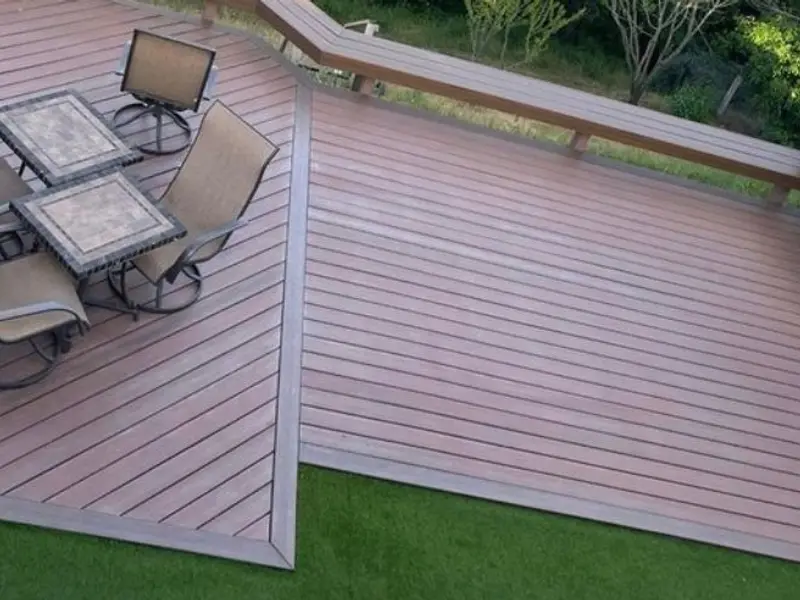
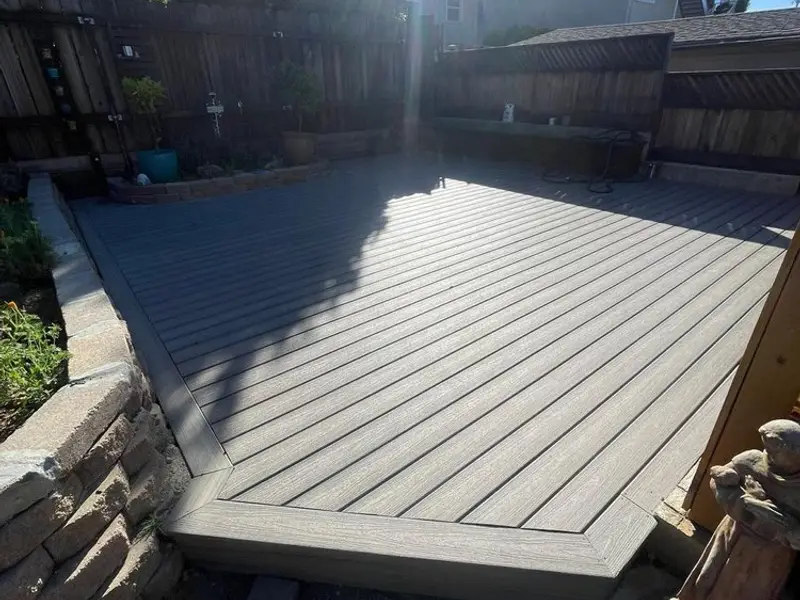
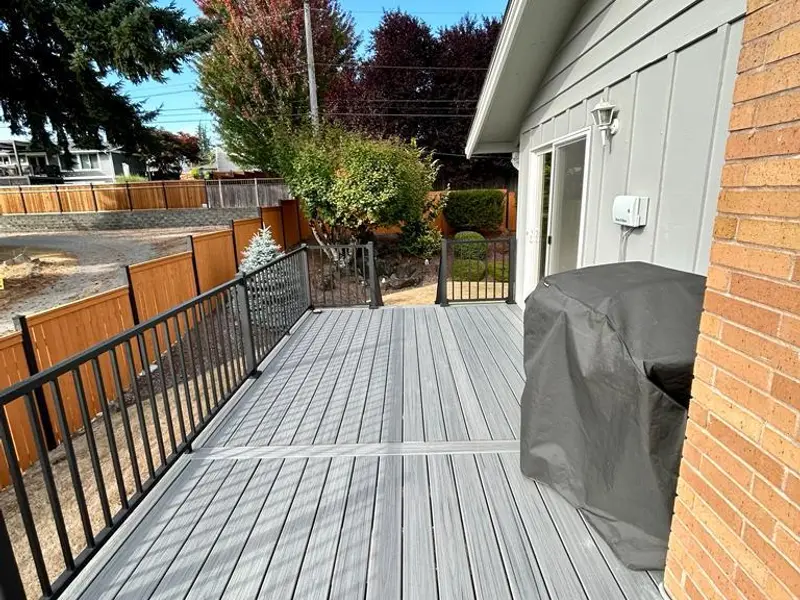
Decks we have built recently
4.8 on Google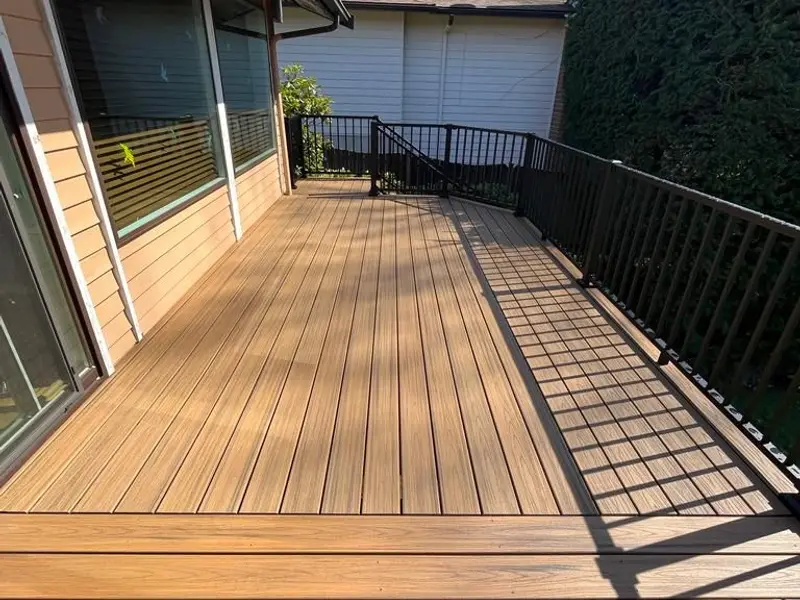
★★★★★Google review"They did an amazing job on our deck right before the holidays and I am so glad we listened to Josh and finished the project on time."
What Type of Waterproofing Is Best for a Deck?
It depends on what is under the deck. A balcony over a bedroom needs a true waterproof membrane; a wood deck over open ground only needs a sealer. California law counts flashings, membranes, coatings and sealants together as the waterproofing that protects a balcony's structure (Health and Safety Code 17973).
Liquid-applied traffic coatings
Layers of coating built up over plywood or concrete into one continuous, textured walking surface, used on balconies and walkways over living space.
Vinyl sheet membranes
Heavy vinyl sheets glued down with welded seams, turned up the walls and over the edges. They give a finished, patterned surface in one layer.
Membranes under tile or pavers
When the deck surface is tile or pavers, a membrane and a drainage layer go underneath, because grout and joints are not waterproof. Pavers on the ground are a different job; see hardscape.
Sealers for open decks
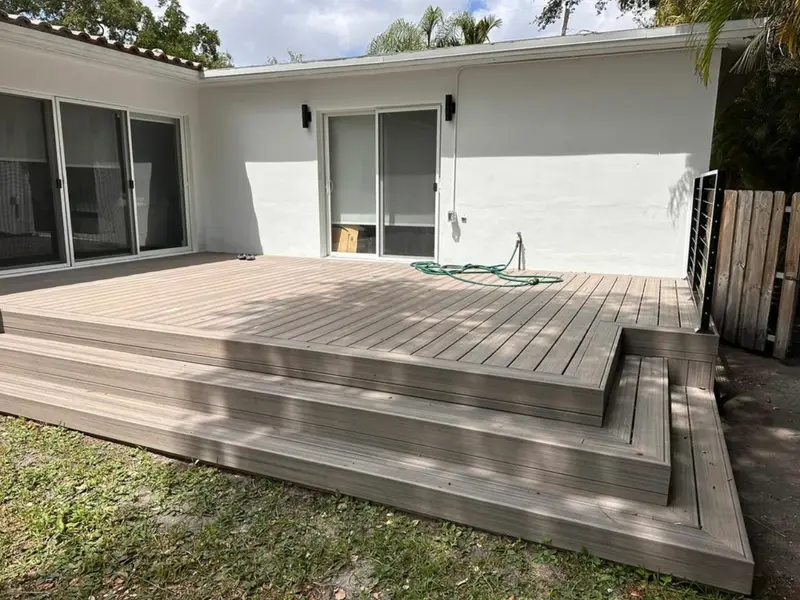
A wood or composite deck with nothing but ground below is not waterproofed; wood boards get a water-repellent sealer to slow weathering. Those decks are on our deck building page.
Where Balcony and Deck Leaks Start
Water often gets in at the edges and joints rather than through the open middle of the deck.
Deck-to-wall joint
The membrane has to turn up the wall behind the siding or stucco and lap under the wall's water-resistive barrier. That barrier is required behind the cladding and behind deck ledgers (section R703.2). The wall side is covered on our siding page.
Door thresholds
A door onto the deck needs a pan or flashing under its sill; water at the threshold runs straight into the floor below.
Drains, scuppers and slope
A deck has to slope to its drain or edge. Ponding water and clogged scuppers keep the coating wet until it fails.
Railing posts and cracks
Every post or bracket screwed through the surface is a hole to seal, and cracks in a worn topcoat let water reach the plywood.
California Balcony Inspection Laws: SB 721 and SB 326
Two state laws require periodic inspections of balconies, decks, stairs and walkways that are more than 6 feet above the ground and supported by wood. The inspection reports often call for waterproofing repairs.
Apartment buildings (SB 721)
Buildings with three or more multifamily units must have these exterior elevated elements inspected, with the first inspection to be completed by January 1, 2026 and then by January 1 every six years (Health and Safety Code 17973).
Who may inspect
A licensed architect or civil or structural engineer, an A, B or C-5 contractor with five years of multistory wood-frame experience, or a certified building inspector, looking at a sample of at least 15 percent of each type.
Condominiums (SB 326)
The association must have a licensed structural or civil engineer or architect inspect a random sample of these elements at least once every nine years (Civil Code 5551).
The SB 721 report
The inspector's report reaches the owner within 45 days of the inspection (Health and Safety Code 17973 (c)(4)). A report that calls for immediate repairs also goes to the local enforcement agency within 15 days (subdivision (d)).
Repair deadlines
For repairs that are not an emergency, the owner applies for a permit within 120 days of receiving the report, then has 120 days to finish once it is approved, unless the local agency grants more time (subdivision (h)(2)). A licensed contractor does the work, following the inspector's recommendations and the maker's specifications (subdivision (g)). We repair and re-waterproof decks and balconies, including that work.
How an Existing Deck Is Re-Waterproofed
A typical re-waterproofing runs in this order.
Strip and open up
Old coating, tile or membrane comes off at the leak and the edges, so the plywood, framing and flashing can be seen.
Repair rot and slope
Wet or rotted plywood and framing are replaced and the surface is sloped so water runs to the drain or edge.
Flash every edge
New flashing goes at the wall, the door sill, the drains and the edge, lapped so water always runs over the next layer, not behind it.
Membrane, topcoat and water test
The membrane or coating layers go on as the system's maker specifies, then the textured topcoat, and a water test checks the deck before the ceiling below is closed.
What Moves the Cost of Waterproofing a Deck?
The deck's size sets a baseline; what is found underneath sets much of the rest. Compare quotes on these points:
Condition under the surface
Ask how rotted plywood and framing are priced if they are found, since they only show once the old surface is off; on an SB 721 job, the inspector's report sets the minimum scope.
System, details and removal
The system (traffic coating, vinyl sheet or a membrane under tile) sets the material. The code requires flashing where a deck attaches to a wood-frame wall (section R703.4), and each door pan, drain, scupper and railing post adds detail work. Taking up old tile and the final water test should be written into the scope.







Deck and Balcony Waterproofing FAQ
How do I keep the patio under my deck dry?
For an open deck over a patio, an under-deck drainage system catches water between the joists and carries it to a gutter, so the boards above stay as they are. A deck over a room needs a waterproof membrane on top instead.
When does a deck coating need a new topcoat?
When the textured topcoat wears smooth in walkways, the base layer shows through, or small cracks appear. Recoating then protects the layers below from wearing through.
Can I put tile on my balcony?
Yes, with a waterproof membrane and a drainage layer under the tile and the right slope. Tile and grout alone let water through to the deck below.
What are the signs a balcony is leaking?
Stains or bubbling paint on the ceiling below, soft spots underfoot, a peeling or blistered coating, and cracks or rust streaks in the stucco under the deck edge.
For the full outside of the house, see exterior remodeling. To have a leak looked at, tell us what you see on the deck and the ceiling below and book an appointment.